

Amda is here for you.
Support and Advice Center 8889 *
Digital course

Mickey Berkowitz's story – their reality: "Grieving for mother while she is alive"
- Or Hadar
- Published on Ynet
- No comments
The decision by the family of basketball player Mickey Berkowitz to reveal that he has been diagnosed with dementia has cast a rare spotlight on a disease that often remains behind closed doors. Ofir Rubinstein, a brother at Shamir Medical Center (Assaf Harofeh) whose mother, Bala, is battling Alzheimer's, has returned to live with her and describes the difficulty of caring for a sick family member: "Her deterioration was rapid, like a ballistic missile."
Ofir Rubinstein's mother is no longer really with him, even when she sits next to him in the same room. Blaha (80) was diagnosed with Alzheimer's about a year ago. "Her deterioration was rapid, like a ballistic missile," describes Rubinstein (45). "On an emotional level, the hardest moment for me was when I realized that you start to mourn your mother while she's still alive, because she's no longer the same person. On the one hand, it allows you to prepare yourself for the dark day when she's no longer there. On the other hand, it's a bit surreal to realize that physically your mother is present in the house, but on an emotional level she doesn't really act like your mother, because she's not aware of you."
The decision of the basketball legend's family Mickey Berkowitz to reveal he has been diagnosed with dementia with Lewy bodies It shone a spotlight on a disease that often remains silent, behind closed doors – and opened an important public debate."Amda" Association, which works for people with dementia and Alzheimer's and their families, estimates that there are about 150 dementia patients in Israel - for which there is not even an official national registry, and of those estimated, only a few tens of thousands have not yet been diagnosed at all.
Ofir Rubinstein describes the difficulty of witnessing his mother's deterioration: "Within eight months, she no longer recognized things. From a cognitive test with a score of 25, she dropped to a 10. In recent weeks, she has been in a state where she is almost completely disconnected - for example, using inappropriate objects, trying to open the door with a sandal, or bringing me a roll of toilet paper and telling me that this is the to-do list. It is complex and difficult," Rubinstein continues.
"You got confused between salt and sugar"
Blaha's cognitive decline began about three years ago, starting with small things. "Suddenly she called me and asked me how to make tomato sauce for pasta - something she used to make every week, she was an excellent cook and baker," Rubinstein recalled. "Most of it started with simple things related to the kitchen - she would confuse sugar with salt, or her food would burn."
The deterioration was also preceded by a severe family trauma: five years ago, Balaha's eldest son of three, Eran (Ruby), unexpectedly died of cardiac arrest. The health of both parents began to deteriorate from that point on. "At the funeral, we saw the first sign, when my father was unable to stand on his feet. Later, Parkinson's broke out in him and he became a caregiver," Rubinstein says. "As long as my father was a caregiver, my mother remained alert, because he had to be taken care of. But from the moment we brought in a foreign caregiver for him and the responsibility was removed from her, we saw a significant deterioration."

"It was a year of confrontations," he describes the difficulty in accepting his mother's condition at that time. "I would get into arguments and fights with her, because I couldn't understand why she didn't remember, why she didn't understand, how she could say she wasn't in her own house – that we had moved the house."
Blaha had already been diagnosed with mild dementia, but with the significant deterioration, Rubinstein and his brother Amit sought further clarification. Due to the long waiting times at the health insurance company, the two chose to turn to the private sector, to Dr. Natale Blinson, a specialist in geriatrics and psychogeriatrics. At the end of the clarification, the difficult news was received: Blaha has Alzheimer's.
Dad was doing CPR, Mom was reading a newspaper.
Last January, a few months after receiving the diagnosis, the father, Yaakov, also passed away. "That's when we realized how disconnected my mother was," says Rubinstein. "While the therapist was giving my father CPR and we were waiting for the ambulance, with my father lying on the floor in the living room, she was sitting on the couch reading a newspaper. She didn't understand the situation at all. Even when she read my father's name on the tombstone, she just said: 'Yes, I know someone like that.'"
When his father passed away, Rubinstein decided to move back in with his mother. "After he passed away, I felt like I missed a lot of things with him in recent years, and I missed opportunities to spend time with him and make memories with him, so I chose to leave my apartment and go home," he says. "Nowadays, I get home from work relatively early twice a week, and my mother and I play Rummy, Ladders and Snakes, or watch a movie together. Once a month, on the weekend, we go for a walk with her and the therapist - we went to the Biblical Zoo, to the Stalactite Cave, and one of the exciting things is that she experiences it like a child for the first time, even though it's not really the first time. You can see the enthusiasm in her face."

Rubinstein, a nurse by profession and an instructor at the nursing school at Shamir Medical Center (Assaf Harofeh), says that following his mother's illness, he began developing an advanced course for nurses and nannies, which also deals with family caregivers. "We keep saying that the patient is at the center, but he can't be at the center if we are not aware of the family members around him."
"At first, it was very difficult for me to deal with the illness, but what helped me come to terms with myself was the understanding that I was allowed to feel negative feelings toward my mother, alongside the good feelings. That I was allowed to be angry with her and even hate her, and at the same time understand that this wasn't really her. This very understanding allowed me to release the self-flagellation I felt. I was constantly feeling like, 'How dare I think bad things,' how dare I think that maybe it would be better if she died and that way a weight would be lifted from my heart. But once I realized that I was allowed to feel that too as a caregiver for a sick family member, and that I wasn't the only one who felt that way, it helped me a lot. It allowed me to be calmer and take advantage of the time with her here and now."
Alongside the emotional struggle, Rubinstein points out another major difficulty: dealing with the bureaucratic system and the lack of clear information about the rights his mother is entitled to. "With National Insurance, filing a claim is very simple, but once it's approved, you don't know what to do with it. No one explains to you what it means or how to use it. To this day, I haven't been able to understand how through National Insurance you can purchase absorbent products at reduced costs. Even now, I feel like I'm more ignorant than informed."
Who will diagnose them?
The story of Rubinstein and his family is the story of thousands of families in Israel. Dementia is an umbrella term for a group of symptoms that indicate impairment in brain function – including memory, language, recognition, perception and judgment – and may also manifest itself in behavioral changes and decreased functioning. Various diseases can cause dementia, the most common of which is Alzheimer's disease.
Dr. Nati Blum, a social worker and CEO of the EMDA Association, explains that "about 60% of people with dementia are dealing with Alzheimer's, about 20% with vascular dementia (following a stroke), and about 15% with dementia with Lewy bodies. The rest are dealing with other types of dementia." According to her, between 4% and 6% of dementia patients are young people who were diagnosed before they reached the age of 65.
Family members who provide care are under a great physical, financial and mental burden, with the systemic difficulties beginning with the attempt to understand what is happening to their loved one and receive a diagnosis. "In the public system, the wait for a diagnosis can be very long," says Dr. Blum. "The priority is for a diagnosis with a cognitive neurologist, but there are only about 15 of them in the entire country, and the lines can reach six months or even more." Unlike cancer, she emphasizes, early diagnosis of dementia will not save lives, and there are currently no drugs that cure the disease - but there are ways to delay the deterioration, and therefore early diagnosis is of great importance: it allows the patient, at a stage when the disease is still in its infancy, to be a partner in decisions concerning his future.
CareGivers, the Israeli organization for family caregivers , also notes that a significant portion of the referrals come early on. Rachel Ladani, founder and CEO of CareGivers Israel, says that about a third of those who contact the organization's counseling and support center are family members caring for people with dementia and Alzheimer's, and 77% of those who contact this issue are women - spouses and daughters caring for a sick parent. "A significant portion of the referrals come early on in the initial investigation and diagnosis stages, when the family is still trying to understand whether the changes they are seeing are 'just forgetfulness,' what needs to be checked, and who to contact."
According to her, about half of the calls raise concerns about safety in the home and kitchen, more than a third raise concerns about the loneliness of the family member providing care, 29% raise questions about rights and benefits and the need for guidance in understanding and implementing them, and 28.6% raise concerns about difficulty in coordinating and dividing responsibilities between siblings. "The length of the conversations also indicates the complexity," adds Ladani. "A conversation about dementia is almost twice as long as an average conversation at the center. Applicants ask how to leave mom alone at home, who will be with her, how to divide responsibilities between siblings, how to deal with bureaucracy, and how to continue to manage their own lives amid the complex challenges."
The price paid by family members
"We are talking about the intensity of challenges and difficulties experienced by family members of a dementia patient, with many families getting lost in the midst of treatment that is very demanding and long," says Varda Sharagai, a social worker and expert in the care of dementia patients and their families inIsraeli Alzheimer's Medical Center"We see many families who have a real difficulty surviving amidst the ongoing deterioration of the disease. If we compare it to a baby – then a baby also depends on you, but in his care there is at least hope. A dementia patient depends on you completely, but there is no hope and no future."
According to Shargai, the professional literature speaks of harm to the mental health of family caregivers. "There is a lot of emotional burden, depression, a sense of loneliness. They are closed in on the treatment of the sick family member. The feeling is that we are constantly losing parts of the person we are caring for – it is a daily experience of ongoing loss." According to her, there is also a constant conflict between the absolute commitment to the patient and the personal desires and needs of family members: "I hear from family members sentences like 'my life is in limbo,' 'I have no life other than my own,' or 'my functioning is robotic, lacking joy in life.'"
Along with the emotional difficulties, many family members also find themselves uncertain about the information they need to understand how to cope and how to move forward after receiving the difficult diagnosis. "They receive this bombshell that falls on them like thunder on a clear day, but they leave the doctor's office with no information at all. They get lost, they don't know where to start," says Shragai. "At our call center within the center, we start explaining to them from A to Z what this disease is all about and how to treat it."
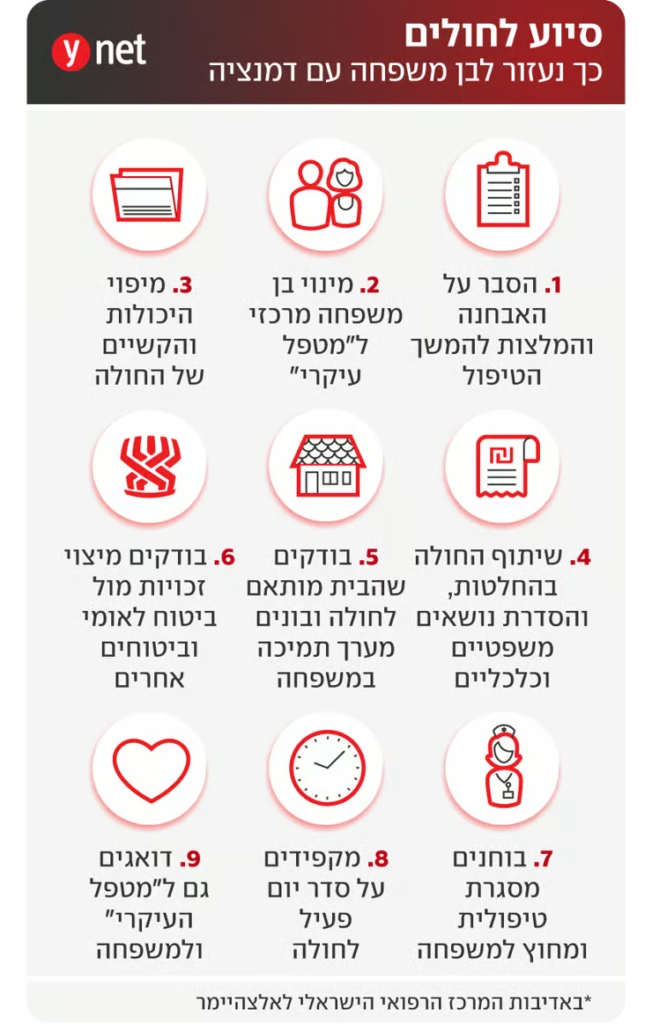
"A little air to breathe"
One of the systemic difficulties that Dr. Blum points out concerns the way in which eligibility for a long-term care benefit from National Insurance is assessed. "The Long-Term Care Law has six levels of eligibility. Often, they check whether the person eats alone, dresses alone, or showers alone. But in dementia, and especially in Alzheimer's, a person can still walk and talk, and yet need close supervision because they may endanger themselves - for example, they could get into the shower, turn on only the hot water and get burned, or leave a pot on the gas." According to her, the system still does not give sufficient weight to the person's cognitive state.
Dr. Blum also points out the financial difficulty that arises when a family is forced to move a sick family member to an institutional setting, as the cost of a private nursing home can reach tens of thousands of shekels per month. "When a person moves to a private nursing home, he loses the nursing care benefit he received when he lived at home, and then he and his family are forced to bear all the expenses," she explains. Another option is to receive a "code" from the Ministry of Health - a subsidy for nursing care hospitalization, the amount of which is determined according to the financial situation of the person and his family members. "For families who do not have the financial means, this is sometimes the only option. Families who have savings understand that at some point they will have to use them to finance the treatment."
Even when the person continues to live at home, the expenses keep piling up: the cost of a caregiver, customized equipment such as a nursing bed or a lift, or renovation costs to adapt the home to their needs. "In the middle stage of the disease, there are families who cannot afford both a caregiver and a day center, and that is a shame," says Dr. Blum. "A day center can help preserve abilities and provide an environment that includes social, physical and cognitive activity, a daily routine, nutrition, the accompaniment of a nurse, physiotherapy and occupational therapy. At the same time, it gives some breathing room to the family members who are caring for them."
According to Shargai, one of the main questions that arises during the care of a family member with dementia is when is the best time to institutionalize him. "Families have feelings of guilt, because they think it means they are not dedicated or loving enough - but on the other hand they collapse. I always tell them that the only criterion is when they feel that they are not doing a professional job. As long as you can continue to care at home, that is great, with all the love and support, but as soon as you feel that professionals are needed - that is the time."
Dr. Blum concludes that alongside the personal and family difficulties, there is also a broader problem of low public awareness of brain health. "I also attribute this to the state, because they talk about dental health, they talk about heart health, they talk about various types of cancer - but no one talks about brain health," she says. "We cannot completely prevent these diseases, but we can certainly reduce the risk of contracting them by about 30% to 40%, and they are very serious and sad diseases. We need to raise awareness of brain health from a young age."

Subscribe to the newsletter
The leading newsletter in Israel on the topics of Alzheimer's, dementia and similar diseases.
Telephone support and consultation center - *8889
Free initial support - information, advice and guidance
For families with dementia and Alzheimer's
Zoom consultation hour
Video meeting with an expert
To support families with dementia and Alzheimer's
Home support - Telam program
Three meetings at home
and two years of telephone support
in-person support group
Guidance and support in a monthly meeting for family caregivers
Dozens of groups across the country, free of charge
Zoom support group
Guidance and support in a monthly meeting for family caregivers
A variety of Zoom groups, free of charge
Closed Facebook group
For sharing and answering questions 24/7, free of charge
Thousands of members, answers from experienced people and professionals
Silent WhatsApp community
Updates, knowledge, tips and tools, free of charge
For family caregivers and professionals
Dementia course for family caregivers
Preparing to cope with dementia in the family
Digital course you can take from anywhere
In EMDA's WhatsApp community, only EMDA posts messages.
Improve the care of your loved ones!
Digital course in English or Russian
EMDA Store
Activity kits for a person with dementia,
And a variety of other solutions for families